
WiFi 7 for Businesses in Ecuador: Is It Worth the Investment Over WiFi 6E?
The WiFi 7 (IEEE 802.11be) wireless standard has officially matured across corporate networking portfolios in 2026. Promising throughputs over 40 Gbps, 320 MHz ultra-wide channels, and sub-5ms latencies, many IT managers across Ecuador are assessing whether to upgrade corporate access points or maintain WiFi 6/6E setups.
Three Core Breakthroughs of WiFi 7
Unlike previous generational updates that focused primarily on peak theoretical bandwidth, WiFi 7 introduces fundamental structural innovations for high-density environments:
- Multi-Link Operation (MLO): Where WiFi 6 binds clients to a single band (2.4 GHz, 5 GHz, or 6 GHz), MLO allows devices to transmit and receive across multiple frequencies simultaneously, virtually eliminating jitter and packet drops.
- 320 MHz Channel Widths: Doubles channel capacity in the 6 GHz spectrum, outpacing traditional Gigabit wired links.
- 4096-QAM (4K-QAM) Modulation: Provides a 20% data density boost compared to WiFi 6's 1024-QAM.
When Is Upgrading Justified for Ecuadorian Enterprises?
While standard administrative offices with 15–30 staff members remain well-served by WiFi 6, moving to WiFi 7 delivers immediate competitive advantages in:
- Logistics Centers & Automated Warehouses: Handheld RFID scanners and AGV robots requiring seamless roaming with zero packet dropouts across vast facilities.
- High-Density Corporate Hubs & Tech Campuses: Auditoriums, open-plan workspaces, and software houses where hundreds of wireless clients compete for airtime.
- Medical and Educational Facilities: Real-time high-definition imaging transmission and concurrent digital learning labs.
Underlying Infrastructure Prerequisites
Deploying WiFi 7 access points over obsolete wiring creates severe bottlenecks. Upgrading requires:
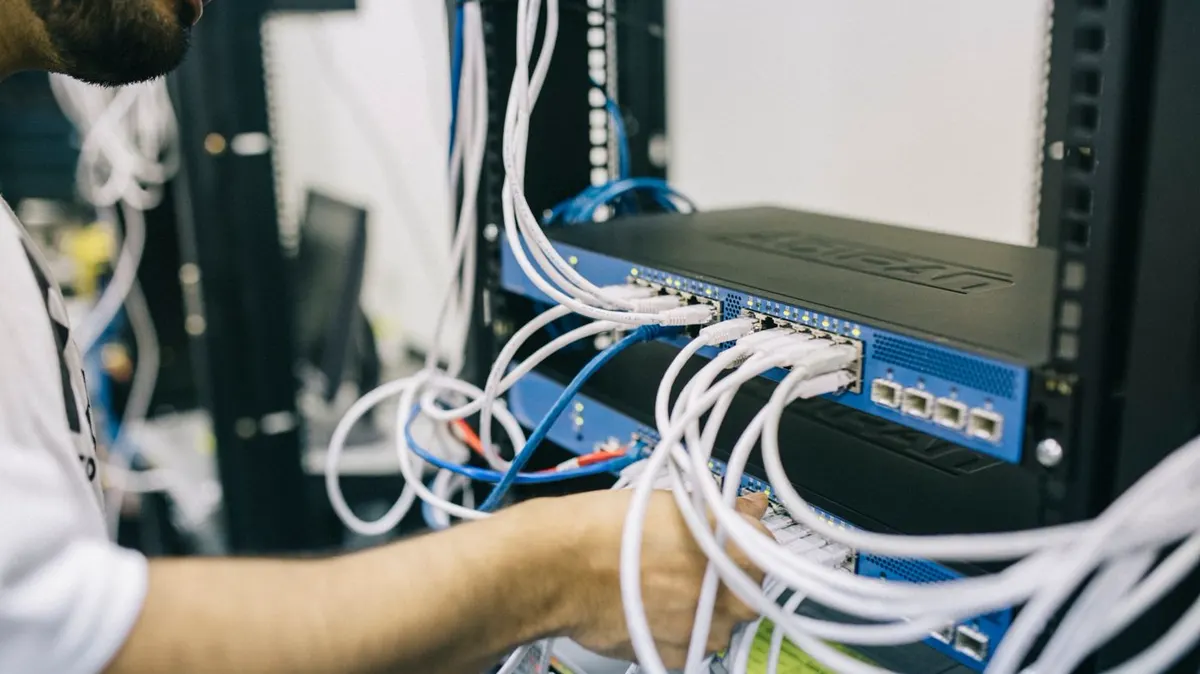
- Multi-Gigabit Switches (2.5G / 10G PoE++): Switch ports delivering at least 2.5 Gbps with 802.3at/bt PoE power delivery.
- Certified Cat 6A Cabling: Ensuring 500 MHz frequency support up to 10 Gbps over 100 meters.
How We Build at SimCodec
At SimCodec, we engineer, deploy, and certify enterprise wireless networks (Ubiquiti UniFi, MikroTik, Cisco, Aruba). We conduct RF site surveys, eliminate channel interference, and guarantee seamless roaming across your facilities.
Planning a wireless network refresh? Let's connect: at SimCodec we engineer networks designed for tomorrow.
What sets WiFi 7 apart from WiFi 6 for businesses?
WiFi 7 (802.11be) introduces Multi-Link Operation (MLO), letting a device transmit across multiple bands at once, 320 MHz channels that double the available width in the 6 GHz band, and 4096-QAM modulation offering 20% more data throughput than WiFi 6.
Do all businesses in Ecuador need to migrate to WiFi 7?
No. For standard offices with 15 to 30 employees doing web browsing and email, WiFi 6 remains fully competent; upgrading to WiFi 7 pays off most in automated warehouses (RFID, AGVs), high-density offices, and medical or educational facilities.
What infrastructure is needed to take advantage of WiFi 7?
You need Multi-Gigabit switches (2.5G or 10G) with PoE+ or PoE++ power, plus certified Cat 6A structured cabling supporting up to 10 Gbps over 100 meters; deploying a WiFi 7 access point over old cabling creates bottlenecks.